Basic Policy for MLF Use
The Materials and Life Science Experimental Facility (MLF) is available to Japanese and international users for academic research and industrial applications. To ensure fair, transparent, and user-oriented management, various committees have been established, and a peer review system involving experts from Japan and abroad has been implemented.
- International Advisory Committee (IAC)
- User Consultative Committee
- Materials and Life Science Experimental Facility Advisory Board
- Neutron/Muon Science Proposal Review Committee
- Neutron/Muon Instrument Program Review Committee
Beamlines at MLF
There are 23 neutron beam extraction ports for the pulsed spallation neutron source and four muon extraction channels for the muon target at MLF.
There are three categories of Beamlines at MLF.
J-PARC Center Beamlines
Neutron / Muon beamlines installed, maintained and managed by JAEA / KEK ( except Public Beamlines)
Public Beamlines
Neutron beamlines installed and maintained by JAEA and managed by the Registered Institution for Facility Use Promotion (RIFUP).
Third-party Beamlines
The beamlines installed, maintained and managed by third parties. The third party must supply a certain fraction of the beamtime to general use in exchange for having exclusive rights to the beamline.
Categories of Beamtime
To maintain a high level of performance of the beamlines and to meet the various needs of the users as well as to strive to encourage users to create outstanding scientific results, J-PARC / Public beamlines have beamtime not only for General use, but also for Project and Instrument use. Third-party beamlines have fractions for Third-party exclusive use and General use.
Beamtime for General use
General use beamtime is widely available to Japanese and overseas users for short-and long-term proposals. A Principal Investigator (PI) must be an employee of or affiliated with a legal organization or entity that may be any of the following:
A public or private college, university or other institution of higher education A public or not-for-profit research organization A private company A postdoctoral researcher can also submit proposals as a PI with the permission of his/her senior. Limited to short-term proposals, a graduate student (master’s and doctor’s course) can be the PI with the permission of his/her academic supervisor. Undergraduate students or persons without affiliation cannot be the PI.
Beamtime for Project and Instrument use
Project and Instrument use is the fraction of beamtime in which JAEA/KEK/RIFUP conduct their mission-oriented programs or joint research programs with universities or other organizations.
The PI should be a JAEA/KEK/RIFUP member. The KEK joint research program allows a university researcher to become PI under KEK rules.
Beamtime for Third party exclusive use
Ibaraki Prefecture has neutron beamlines for exclusive use and invites their industrial use. Please check the URL below for details. https://www.pref.ibaraki.jp/sangyo/kagaku/tyusei/bl-top-english.html
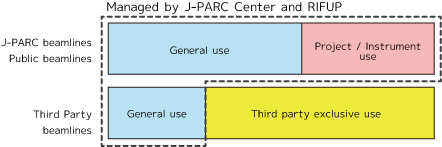
Beamtime allocation
Beamtime is allocated by reviewing proposals submitted through J-PARC proposal application programs.
Proposals for J-PARC beamlines and for General use of Third Party beamlines are called by J-PARC Center, while proposals for Public beamlines are called by RIFUP. J-PARC Center and RIFUP jointly carry out an open proposal review system and hold the following Proposal Review Committees.
- J-PARC: Neutron/Muon Science Proposal Review Committee (NSPRC/MSPRC), Materials and Life Science Experimental Facility Advisory Board
- RIFUP: Proposal Evaluation Committee (PEC), Selection Committee
All proposals are reviewed in NSPRC/MSPRC and PEC, where they are categorized approved or not, and the beamtime to be allocated is determined when categorized as approved.
The Materials and Life Science Facility Advisory Board and Selection Committee confirm the proposal review results.
J-PARC Center and RIFUP conduct beamtime allocation.